Sarajevo
International Airport has terminated its contract with Fly Bosnia after the
airline failed to pay its debts.
This
information was confirmed to Bosnian news portal Klix by Sarajevo airport,
stating that the suspension of Fly Bosnia has started on September 18th
of this year.
"Considering
that the airline did not settle its debts within the given period of 60 days,
nor did it accept the proposal on the manner of debt repayment, the contract on
providing services for receiving and dispatching aircraft, passengers and
luggage between Sarajevo International
Airport and FlyBosnia was terminated on November 17. 2020.” Sarajevo airport
said.
In addition, Sarajevo
Airport added that all necessary legal actions will be taken.
"In
connection with the goal of protecting its financial interests, a request for
activation (collection of a bank guarantee), was submitted today (November
18)," Sarajevo airport added.
In
December of last year, Fly Bosnia confirmed to Klix portal that they had agreed
to repay the debt to Sarajevo Airport, but also did not want to state how it would
be done and what the amount was.
Sarajevo airport
confirmed that the debt was not paid
despite the mentioned agreement.
Public
Enterprise Bihac Airport has applied to
the Federal Ministry of Transport and Communications for the funds to continue the
construction of the test section of the runway by the end of the year. Funds
from the Federal Government are expected
in the coming weeks. Also, by the end of the year, Bihac Airport expects the
completion of the Aeronautical Study and the Revision of the Main Project.
Bihac
Airport submitted the Request for the Urban Planning to the Federal Ministry of
Planning and Construction. At the beginning of 2021 Bihac Airport is hoping to
get all necessary water and waterways protection permits, and finally by the
end of 2021 hoping to take a historic
step by applying for building permit.
In
addition, the airport is expecting that
through the Law on Public-Private Partnership, it will be competitive with
potential investors with whom they have already passed a certain number of
steps, believing that Bihac Airport will achieve cooperation through the
"build-operate-transfer" model.
The
airport emphasizes that the funds for the previous activities were provided by
the Federal Ministry of Transport and Communications, with promises that Bosnia
and Herzegovina federal government will continue to finance the improvement and
construction of the project, because the Airport in Bihac is the obligation of
the Government of the Federation of Bosnia and Herzegovina.
So
far, the expropriation of land for the needs of the construction of the airport
has been carried out according to the agreement from March 19. 2019, in the
total amount of 6,612,100 Bosnian Marks.
For
the purchase of land with an area of 264,484 m2, 2,000,000 KM was paid on
March 19. 2019, then 1,500,000 KM on July 29. 2019, and another 2,000,000 KM on
November 7.2019.
So far, the total amount paid for land expropriation amounts
to 12.112.100 Bosnian Marks or 6.192.818 Euros.
The
rest of the debt for land expropriation in the amounts of 1,112,100 KM should
be paid by December 31, 2022 at the latest.
Sarajevo International Airport
has posted statistic data for October, reflecting large decreases in all areas
of operations due to global coronavirus pandemic. During the month of October a
total of 21.416 passengers traveled through Sarajevo Airport, representing a
decrease of 77% or 74.212 passengers less when compared to the same month of
the last year. Number of operated flights decreased by 45% or 502 flights less, while transported cargo
recorded decrease of 20%.
European aviation is feeling the burden of the COVID-19
crisis even more heavily than other world regions. Its year-to-date cumulative seat capacity is down
by 55% – worse than in any other region.
Moreover, according to IATA, its airlines generated negative
free cash flow at -83% of revenue in 2Q2020, versus an average of -52% for all
regions. Preliminary 3Q2020 results from the leading European airline groups,
Lufthansa, IAG and easyJet, indicate that they have continued to burn through
cash at a rapid rate.
Europe's year-on-year cut in seat capacity narrowed slightly
to -62.1% in the week commencing 26-Oct-2020, the first week of the winter
2020/2021 season, compared with -63.4% in the previous week. This was the first
improvement in the trend in 10 weeks, but Europe still has the equal biggest
reduction in capacity, tied with Middle East on -62.1%. Africa is -58.4%, Latin
America -57.4%, North America -51.5%, and Asia Pacific is -38.4%.
Globally, airlines are expected to continue to burn cash
until at least the end of next year, but Europe's airlines may struggle for
cash break-even for longer than that.It is a sure sign that things are desperate when Europe's
airlines, pilot unions and airports all agree. Jonathan Hinkles, CEO of the UK regional airline Loganair
argues that without testing at airports, UK aviation is "whirling around
like a leaf in an autumn storm".
EUROCONTROL member states
✈EasyJet CEO Johan Lundgren says "Aviation continues to
face the most severe threat in its history".
✈Virgin Atlantic CEO Shai Weiss warns that "without mass
testing", the UK's economic recovery "will not take off".
✈British Airways Airline Pilots' Association general secretary Brian
Strutton believes "UK aviation is in a death spiral".
✈Augustin de Romanet, chairman/CEO of Groupe ADP, owner of
the two main Paris airports, fears the "entire airline sector is slowly
dying".
After reaching peak recovery in Aug-2020, Europe is now
eight weeks into deepening year-on-year capacity cuts. Seat numbers are down
-62.2% in the week commencing 12-Oct-2020. Only Middle East has a deeper cut,
with -63.2%; Africa is -59.1%, Latin America -56.7%, North America -51.6%, and
Asia Pacific is -39.0%.
The European aviation industry urgently needs standardized,
consistent COVID-19 testing to replace the web of quarantine restrictions that
are choking it. After nine successive weeks of progressively worse
year-on-year declines, Europe now has the deepest capacity cut of all the world
regions.
Seat numbers have been cut by -63.4% in the week commencing
19-Oct-2020. Middle East, previously occupying last place, now moves above
Europe with a -62.8% cut, while Africa is -59.1%, Latin America -57.8%, North
America -52.1% and Asia Pacific is -39.2%.
Ryanair, Europe's biggest airline, has cut its winter
capacity plan from 60% to 40% of 2019 levels. EUROCONTROL DG Eamonn Brennan
told CAPA Live October that he expected air traffic movements in Europe at 40%
of last year's this winter, which suggests a lower figure for seat capacity
(since long haul flights, with more seats, have been cut more heavily than
short haul).
The EU's 'traffic light' approach to travel restrictions
does not seem likely to alleviate the outlook to any meaningful degree. With
Europe's aircraft perhaps only half full on average, passenger numbers could
fall short of 25% of prior year traffic, pushing revenue even lower.
From pandemic towards recovery – tracking the evolution of
European aviation during the pandemic.
We can expect European airline bankruptcies by the end of
this winter.
The ANKER (Airline Network Knowledge Expertise & Research)
The report for European Airport Traffic Statistics for January-September 2020 is showing huge decline in passengers numbers compared to the same period of last year due to coronavirus pandemic. The report is showing passenger numbers by majority of European airports by each European country.
-
Source and Copyrights Ⓒ 2020 The ANKER Report and flyingBosnian (www.anker-report.com)
The government of the Federation of Bosnia and Herzegovina held
a session on October 22, 2020 and passed a decision on suspending fees for the
development of air traffic until 31.12.2021.
The abolition of this fee should result in a reduction of
airline ticket prices to the satisfaction of all passengers, as well as
airlines operating from Sarajevo International Airport.
The fee was introduced based on the decision of the government
of the Federation of Bosnia and Herzegovina in 2005 with the aim to develop
civil aviation in the Federation of Bosnia and Herzegovina, and was applied
only to companies operating at Sarajevo International Airport.
The fee of 10 euros per departing passenger from Sarajevo
Airport was used mainly for the reconstruction and development of two other airports
in the Federation of Bosnia and Herzegovina (Mostar and Tuzla International
Airports). Last year, Sarajevo Airport collected €5.763.380 or 11.272.191
Bosnian Marks in the above-mentioned tax.
It is very ironic that the main airport in the country is
collecting this tax just to support Mostar Airport, which is partially owned by
a foreign company – in this case, Zagreb Airport. This is consistent with Tuzla
Airport, which supports foreign airline, Wizz Air, with huge discounts for
airport operations with the funds collected at Sarajevo Airport.
If Sarajevo Airport would like to see a recovery from the devastating
Covid-19 pandemic, its owner (the Government of Federation of Bosnia and
Herzegovina) should invest this tax to bring new airlines that would attract
mass tourism to the city and the whole country, or abolish the tax altogether
in favor of bringing low cost airlines to Sarajevo.
Eurowings has pushed back Sarajevo flights relaunch for December 19th. The airliner was selling tickets for flights beginning next week but due to Coronavirus cases rising in both Germany and Bosnia and even tighter traveling restrictions the airline decided to postpone Sarajevo flights resumption just before Christmas holidays. Both Cologne and Stuttgart will be resumed on December 19th with two weekly flights for both destinations.
➤Cologne-Sarajevo flights will operate on Tuesdays and Saturdays (for Christmas-New Years holidays additional flight will be operated on Thursdays on following dates: 12/24, 12/31 and 01/07)
➤Stuttgart-Sarajevo flights will operate on Tuesdays and Saturdays.
NOTE: Changes to schedules are likely possible due to unpredictable pandemic situation!
Norwegian Air is resuming flights from Stockholm Arlanda
Airport to Sarajevo on December 19. 2020. after 9 months break due to the Coronavirus
pandemic.
During the summer of 2019 Norwegian Air operated flights from
Stockholm, Oslo, Copenhagen and Gothenburg to Sarajevo. The airline plans to
resume summer seasonal flights from all four Scandinavian destinations if the
coronavirus pandemic is under control without border closures and entry
restrictions.
Banja Luka International Airport terminal building and control tower
➤With the beginning of Winter
timetable on Sunday October 25, Banja
Luka Airport will see major flight reductions when compared to the same time of
the last year. Air Serbia will operate two weekly flights from Belgrade while
Ryanair will scale back its operations to Banja Luka from last year’s 5
destinations to only one this coming winter season.
➤Single destination Ryanair plans to
operate to Banja Luka during upcoming winter timetable is new two weekly service from
Gothenburg, beginning October 25.2020.
➤Ryanair will delay the launch of new
flights from Vienna to Banja Luka until March 29, while its planned new route
from Milan-Bergamo has been cancelled altogether.
➤Ryanair is pushing back the resumption of most of its flights to Banja Luka until spring of 2021.
➤Following routes are suspended until Summer timetable 2021. (changes to the schedules are likely possible due to uncertainty with coronavirus pandemic and borders opening and closing on short notice).
During Winter timetable 2020-21
Mostar Airport will not see any scheduled or charter flights. Last winter
season, only airline operating regular flights to/from Mostar was Croatia Airlines
with two weekly flights from Zagreb. Croatia Airlines flights were heavily
subsidized by the Government of Federation of Bosnia and Herzegovina and
Hercegovina-Neretva County.
Due to the Coronavirus pandemic all
flights to/from Mostar were suspended in March of this year without any
indication of flights being reintroduced again.
In December of last year FlyBosnia
introduced one weekly Mostar-Rome flights, but due to pandemic those flights
were short lived.
Without any air traffic Mostar
Airport is solely depending on the government handouts for its survival. With Bosnia
and Herzegovina air traffic down 72% compared to the last year only viable option
for Mostar Airport is to be completely closed until March of next year,
possible longer if airport’s management is not able to secure any flights.
Wizz Air Airbus 320 at Tuzla International Airport
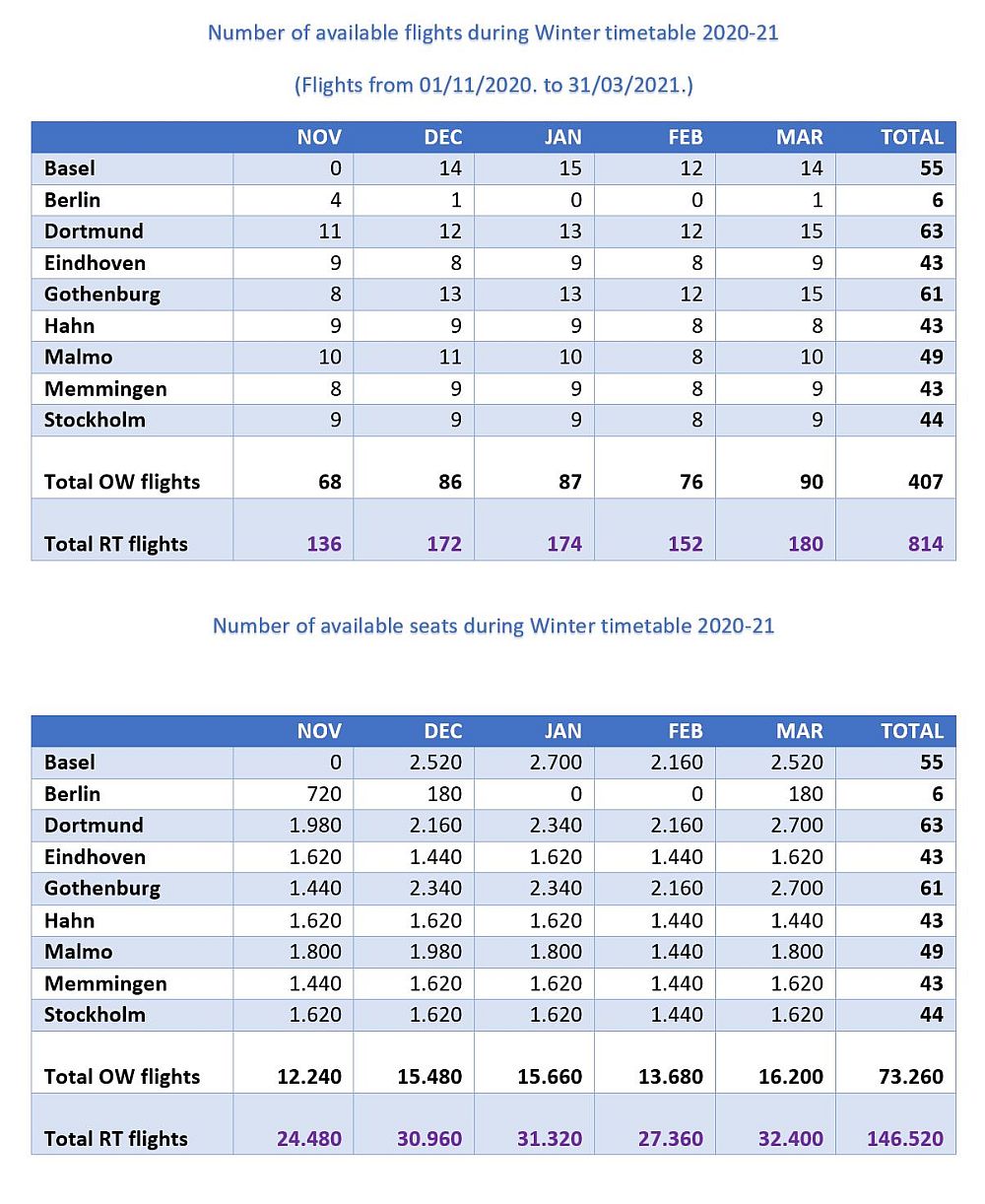
Wizz Air in the last few weeks continue to adjust planned operation, due to various travel restrictions and market demand. As of 19-OCT-20, the airline’s planned Tuzla operations for the month of November 2020 (01NOV20 – 30NOV20) as follows:
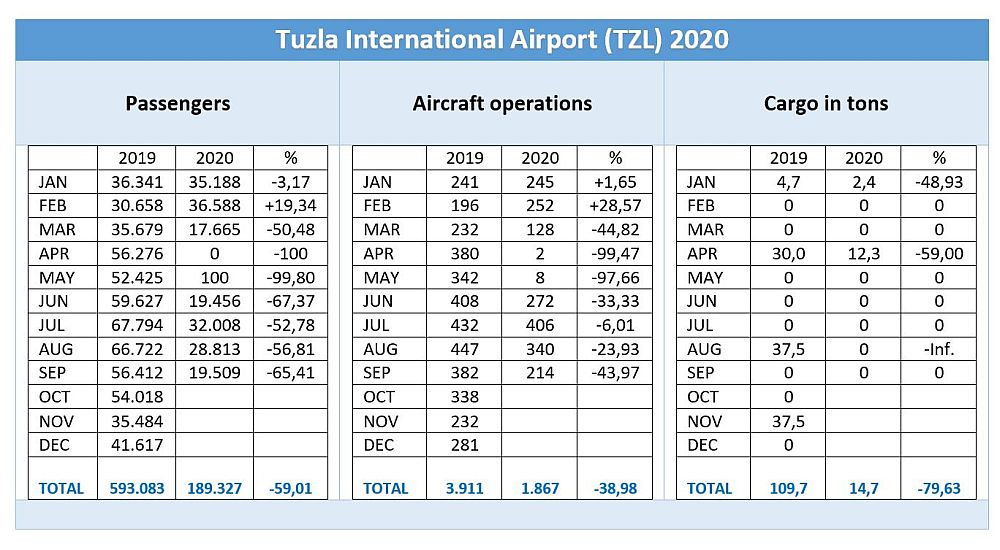
Tuzla International Airport will
see drastic flights schedule reduction during winter months. Wizz Air is still
the only airline operating at the airport with two Airbus 320 aircraft based at
the airport.
The airline has announced
yesterday additional flight cuts to its schedule from Tuzla. During winter timetable
Wizz Air will operate to following destinations:
Basel (restarting
04.12.2020),Dortmund, Eindhoven,
Gothenburg, Frankfurt-Hahn, Malmo, Memmingen and Stockholm-Skavsta.
Following destinations are
scheduled to restart at the beginning of summer timetable in March of next year:
Berlin (flights will operate once per week until 12.04.2020), Billund, Cologne,
Friedrichshafen, Karlsruhe/Baden-Baden, Salzburg, Vaxjo and Vienna.
When compared to the same time of
the last year Tuzla Airport will see 386 fewer flights or 32% decrease. Number
of seats on the offer has decreased from 216.000 to 146.520 or 32% decrease.